Are full face snorkel masks safe?
What is actually known about full face snorkel mask safety: CO2 concerns, panic and removal, research, regulator warnings and why many tour operators ban them.
Some links are affiliate links: if you book or buy through them we may earn a commission at no extra cost to you. How this works.

On this page
Full face snorkel masks became hugely popular in the late 2010s. Around the same time, Hawaii saw a run of snorkeling deaths, and some involved full face masks. That started a debate that is still not settled. Here is what is actually known.
The concerns
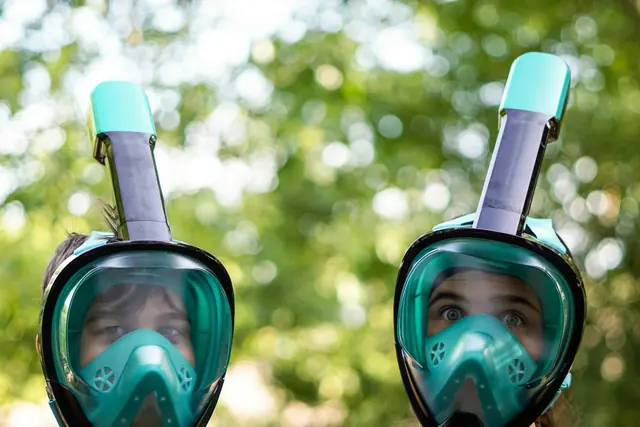
1. Carbon dioxide (CO2) buildup. In a traditional snorkel, you breathe in and out through a tube. In a full face mask, air flows through a larger chamber. If the design does not separate fresh and exhaled air well, some exhaled CO2 can be rebreathed. Symptoms include headache, shortness of breath and dizziness, which can lead to panic. Better-designed masks use one-way valves and separate channels.
2. Removing it in a panic. A traditional snorkel comes out of your mouth instantly. A full face mask covers your whole face and must be lifted off over your head, which is harder when you are tired, panicking or in waves.
3. Fit. One mask must seal around your forehead, cheeks and chin. Beards, small faces and in-between sizes cause leaks, which change airflow and let water in.
4. Effort. The design works best for calm, gentle breathing. Swimming hard against current increases breathing rate and exposes any airflow weakness.
What the research says
- Small studies and tests have found that CO2 levels vary widely between masks, with some poorly designed models performing badly.
- Researchers in Hawaii have investigated snorkeling deaths in general, including a theory that some snorkelers develop fluid in the lungs (pulmonary edema) while snorkeling. That work concerns snorkeling broadly, not only full face masks.
- No study has proven that full face masks cause drownings, and none has shown they are as safe as traditional masks.
The honest summary: the evidence is incomplete, and the concerns are plausible enough that many safety-minded operators choose caution.
Regulator warnings and recalls
Product safety regulators have issued warnings or recalls about specific, usually unbranded, full face masks over design or breathing concerns. Before buying any full face mask, search its exact name with "recall" or "warning."
Tour bans
Many tour operators, especially in Hawaii, do not allow full face masks on board. Some allow only certain brands. Check before you pack one.
If you still want to use one
- Buy from a reputable brand that publishes testing and separates airflow. See best full face snorkel masks.
- Use the size chart. Do not guess.
- Snorkel calmly at the surface. Do not dive down or swim hard.
- Practice taking it off in shallow water.
- Stop at the first sign of headache, dizziness or breathlessness, remove the mask and rest.
- Never let children use one.
Our recommendation
| Pick | Best for | Skip it if | Price |
|---|---|---|---|
Cressi F1 + Supernova DrySafer alternative | Almost everyone | — | Check price |
Ocean Reef Aria QR+If you choose full face | Calm surface snorkelers | Kids, diving down | Check price |
For a full side-by-side, read full face vs traditional snorkel masks. For general safety, see our 15 snorkeling safety rules.